Do you take sugar? A founder’s tale
British Baptist abolitionists have long been celebrated in our written histories. However, evidence shows the originator of the founding bequest for Bristol Baptist College, Edward Terrill, made a fortune trading on the profits of enslaved labour.
This surely deserves further scrutiny and poses several questions, writes Margaret Gibbs
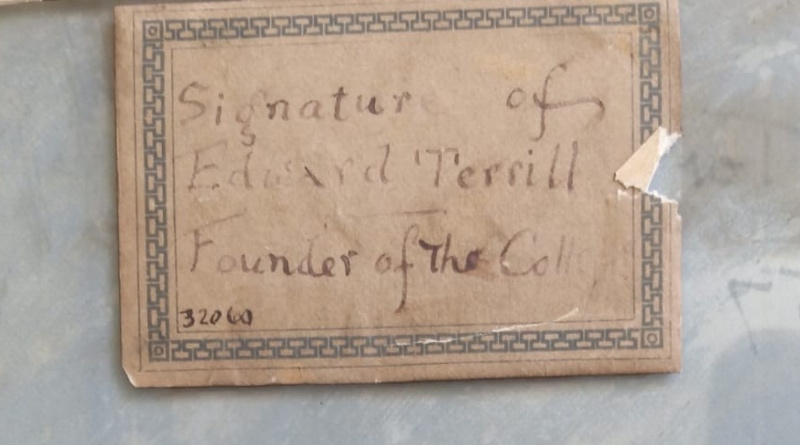
Image | A photo of Edward Terrill's signature from the deed of gift for the founding of Bristol Baptist College, which is held in the college archive | Margaret Gibbs
In his first letter to the Corinthians the Apostle Paul attested that the foundations we choose to build upon determine the subsequent durability and fruitfulness of our work.
In 2022 Bristol Baptist College celebrated 300 years of ministerial formation. It is not only the oldest Baptist College in the Union but indeed in the world.
Its early date sets the originator of its founding bequest, Edward Terrill, in a time of significant pressure, as well as of opportunity, for Baptists in the Port of Bristol. Dissenters in that city experienced significant discrimination but, increasingly, found strength in numbers, and some created wealth through trade as part of an emergent middle class.
Terrill, a key member of the Broadmead Baptist fellowship, worked at first as a scrivener. Recognising a greater fortune to be made, he gradually branched out into importing and refining sugar, which was shipped to Bristol and London from Barbados.
Letters from his fellow-dissenter, agent and brother-in-law Thoman Liston throughout 1666 to 1667 flesh out some of the details of their trading operation. They request regular sums of £400-£500, which Terrill was to advance, to ship 40 to 50 butts of muscovado sugar at a time back to Britain. (The Bank of England Inflation Calculator puts £500 in the 17th century at around £90,000 today.) This high-quality brown sugar was produced on plantations in Barbados through the backbreaking work of enslaved labourers, who had been transported forcibly from West Africa at the height of Britain’s Transatlantic Slave Trade.
Aside from details about sugar, costs, ships and sailing dates there is a silence in their correspondence about what cargoes their chosen vessels were transporting on the other legs of their journeys across the Atlantic. This surely deserves further scrutiny.
What has come down to us however, alongside these letters and the founding bequest for Bristol Baptist College, is Terrill’s Last Will and Testament. This comprises a long litany of significant legacies to family members and fellow believers, which stand testimony to the incredible fortune he made trading on the profits of enslaved labour, as well as to his faith and immense generosity.
Soon after Terrill’s time, Baptists in Bristol and further afield began to support the growing campaign towards the Abolition of Transatlantic Slavery. Was this a response to a movement of the Spirit in their day, as well as to a growing understanding of the injustices being perpetrated through enslavement?
British Baptist abolitionists, including some associated with Bristol Baptist College, have long been celebrated in our written histories. One such is the founder of another Baptist College, Charles Haddon Spurgeon, who arguably lost a fortune in the sales of printed sermons in the American South through his opposition to enslavement. Was it only the passage of time and changes in fashion that set Spurgeon’s stance apart from Terrill’s, living as they did in such different eras and under very contrasting pressures, although with the same underlying faith?
Less self-congratulatory, and much more recently, accounts of the greater sacrifices of enslaved Baptist Abolitionists have reemerged. The battles of leaders such as Sam Sharpe and Paul Bogle are joining the narrative.
Even then, unpalatable aspects of our story are still neglected. Perhaps we have assumed too easily that our predecessors were all abolitionists, or that early Baptists were too poor or suffering too much discrimination themselves, to be associated with the slave trade and its profits. Edward Terrill’s varied choices rebut this view, giving us food for thought and for further research.
In the last few years, a fresh current of the Spirit is at work. A variety of UK institutions, including churches, are facing up more honestly to their historic injustices and considering how to make reparation for consequences and losses which are still being felt. Work to provide the evidence for the continuing legacy of inequality of opportunity and treatment for the descendants of enslaved people in the UK has been done. A growing number of institutions have chosen to apologise and then to take practical steps towards repairing what remains damaged, while others remain silent or in denial.
We know that all histories depend on the viewpoint of the teller, and so no history is final. Our history and heritage as UK Baptists is multi-faceted and will require a diversity of voices to fill out adequately. An Apology for Transatlantic Slavery was offered by the Baptist Union and BMS to the Jamaican Baptist Union way back in 2007.
Beyond words, what more remains? Some significant questions are outstanding. What foundations, good or bad, have we built upon in the past, and what is their legacy? What kind of institutions, healthy or unhealthy, are we inviting people to join today? How should we address our inherited wrongs, so as to build a sounder future?
Let those who have ears listen to what the Spirit is saying to the churches.
Further reading
-
Britain’s Slavery Debt Reparations Now! Michael Banner OUP 2024
-
The Story of Bristol Baptist College Ruth Gouldbourne Pickwick 2022
-
We will Repay: The Biblical Case for Reparations Eleasah P. Louis CTBI, 2023
-
Reparations A Christian Call for Repentance and Repair Duke L. Kwon and Gregory Thompson Brazos Press, 2021
-
Reconsidering Reparations Olufemi Taiwo Haymarket Books 2025
Margaret Gibbs served in Asia and Eastern Europe with BMS before becoming the pastor of Perry Rise Baptist Church, a black majority church in South London. She is now minister at Chesterfield Baptist Church.
A response from Peter Morden, Bristol Baptist College Principal:
"We are moved and challenged by Margaret’s article. As a College we want to stand against slavery in all its forms. There are significant positives in the history of Bristol Academy/College. For example, tutors such as Robert Hall Jr actively campaigned against the trade in enslaved Africans in the former British Colonies and against enslavement more generally.
"But there is also this very challenging side to our heritage which it is important we recognise and reckon with.
"We are grateful that this article draws attention to this and will be reflecting further on the questions raised, both as a staff team and as trustees."
01/10/2026