When families are kept apart: a call to protect refugee family reunion
Why Baptist ministers are being urged to sign a letter to the Home Secretary to protect refugee family reunion. By Steve Tinning
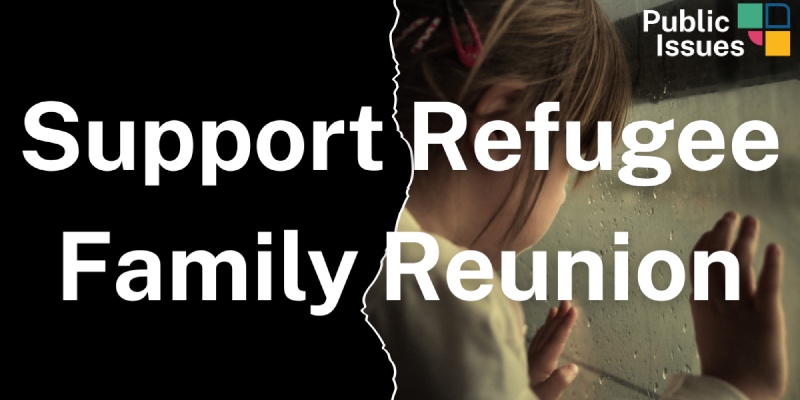
Most, if not all, parents have had that heart-in-mouth moment when you’re in a crowded space with your family and, for a split second, you lose sight of your child. It may last less than a second, but the sense of dread that rushes through you is incomparable. Even writing this now, I can feel it—the tightening chest, the sudden surge of panic, the questions that come unbidden. Mercifully, for most of us, this terror is short-lived. You glance back and they are right there, or just a few steps away, momentarily distracted. Relief floods in as quickly as fear arrived.
For some, though, that moment lasts longer.
I will never forget the day I visited BeWILDerwood, an outdoor adventure park in Norfolk, with my wife, our two children, and my sister’s young family. I was watching the children clamber through treehouses and rope bridges when my sister, Jenny, tapped me on the shoulder. “Have you seen James?” she asked. He was six—full of energy, endlessly curious, always exploring. In that instant, I could see she had already moved past the fleeting panic I had known, into something deeper. James was nowhere to be seen.
For half an hour we searched. My children were sent into tunnels and crevices we couldn’t fit into (while we kept careful watch not to lose them too). Other visitors began to help. Staff reassured us while quietly alerting colleagues across the site. And all the while, I kept glancing back at my sister – as she held her younger daughter closer than I had ever seen – living through something close to hell.
Eventually, James’ dad found him. He had wandered, quite innocently, into another part of the park. He was safe and well, and, well, bewildered about all the fuss.
But for those 30 minutes, we glimpsed something of what it means to be separated from a child – James’ mum and dad most of all.
But what if that separation is not minutes, but months or years? Not always accidental, but sometimes enforced? Not resolved with relief, but prolonged with uncertainty?
In Luke 2:41–52, we find a brief but striking account of Jesus, aged 12, remaining in Jerusalem while his parents begin the journey home. Mary and Joseph assume he is among their travelling companions; it is only later that they realise he is missing. They return to Jerusalem, searching anxiously, and after three days they find him in the temple courts.
It is important not to stretch this passage beyond its intent. Jesus is not a lost refugee child, nor are Mary and Joseph victims of persecution in this moment. Yet the text does not shy away from naming the human experience within it. Mary’s words – “Your father and I have been anxiously searching for you” – speak to a very real parental anguish. Even within a story that ultimately reveals something of Jesus’ identity and vocation, the anxiety of separation is not dismissed.
Scripture allows us to recognise that the separation of parent and child is not a neutral experience. It is something that wounds, that disturbs, that unsettles the very fabric of family life. Throughout the whole of scripture, God’s concern for the vulnerable and the displaced could not be clearer (Deuteronomy 10:18–19, as just one example), and the integrity of family life is treated as something to be protected, not fractured.
Now consider a different kind of separation.
Imagine fleeing your home because it is no longer safe. Not in theory, but in reality – because of war, persecution, or violence. Imagine leaving behind not only your house, but your community, your language, your sense of belonging. And then imagine that, either in the chaos of that flight, or by torturous necessity, you are separated from those you love most: your spouse, your children, your parents.
For many refugees, this is not hypothetical.
Some make dangerous journeys alone, hoping to find safety first and then bring their family to join them. Others are separated by borders, bureaucracy, or sheer circumstance. In these moments, the hope of reunion is not a luxury – it is a lifeline.
For years, the UK has recognised this, albeit in a limited way. Refugee family reunion has allowed those granted protection here to be joined by their spouse and their children. It has never been a wide or permissive route. It has been tightly defined, carefully controlled, and rooted in a simple principle: that protection should include the possibility of family life.
But that principle is now under threat.
The Government has suspended the refugee family reunion route and is proposing to replace it with a far more restrictive system – one that would make family unity conditional on meeting income thresholds and other eligibility requirements. In practice, this means that those who have fled persecution and legitimately found safety here may only be able to reunite with their closest family if they can demonstrate sufficient financial means and meet other criteria.
We should be clear about what this represents. It is not simply a technical adjustment to immigration policy. It is a shift in what we understand protection to mean.
Where family reunion has been recognised as part of the protection we offer, it now risks becoming something that must be earned.
And that has profound implications.
Many refugees arrive in the UK with little. They may be recovering from trauma, navigating a new language, seeking work, and rebuilding their lives from the ground up. Some will find employment quickly; for others it will take time. Some will never reach the income thresholds that may be required – not because they lack character or contribution, but because of the circumstances they have endured.
Under a system that prioritises income and eligibility, those who are already most vulnerable are likely to be those most excluded.
And the consequences are not abstract.
They are borne by families – by mothers raising children alone in refugee camps or precarious conditions; by fathers supporting loved ones from afar; by children growing up without the presence of a parent. Separation is not only emotional; it is practical. It affects wellbeing, education, development, and safety.
As people of faith, we are called to see these realities clearly.
Across our Baptist life, we speak often of human dignity, of justice, of the importance of community and relationship. We affirm that every person is made in the image of God. We recognise that family – however it is formed – is a primary context in which care, nurture and belonging are expressed.
To keep families together is not simply a social good; it is a reflection of the way God has made us. This is not to say that immigration policy is simple, or that governments do not face difficult decisions.
But it is to say that the choices we make in these areas reveal something about the values we are prepared to uphold.
Will protection be defined narrowly, as the absence of danger? Or more fully, as the possibility of rebuilding life – including family life – in safety?
At its best, the church has not been silent on such questions. We Baptists have a long history of speaking into public life – not from positions of power, but from convictions rooted in Scripture, shaped by community, and expressed through advocacy and action.
This is one of those moments. And it is why ministers and faith leaders are now being invited to act.
The Joint Public Issues Team (JPIT), on behalf of the Baptist Union of Great Britain, the Methodist Church, and the United Reformed Church, is inviting ministers and faith leaders to sign a letter to the Home Secretary calling for the protection of refugee family reunion.
The letter is not partisan. It does not deny the complexity of the wider immigration system. But it does make a clear and principled case: that families who have already been torn apart by war and persecution should not be kept apart by policy.
Lynn Green has joined several denominational leaders in signing the letter. Other signatories include Rowan Williams, former Archbishop of Canterbury, Mike Royal, General Secretary of Churches Together in England and Nicola Brady, General Secretary of Churches Together in Britain and Ireland.
Lynn says,
'It is unimaginable to me what refugee parents must endure when they are separated from their children, or the anguish of husbands and wives kept apart. We see throughout the Bible, God defends those whose lives and families are torn apart and expects His followers to give support and dignity to the foreigner among them.
'That prompts a simple question: how do I defend their cause today? For me, signing this letter is one small part of that response.'
It is hoped that many local church ministers, will join her.
To sign the letter is to add your voice to a growing chorus of faith leaders who believe that compassion, justice and human dignity should shape our national response. It is to say, publicly and collectively, that family unity matters – that it is not an optional extra, but an essential part of what it means to offer refuge.
You can find more information, including the full text of the letter and how to sign, at:
jpit.uk/refugee-reunion – if possible, please do this
before 9am on Monday 23 March (although it will be possible to sign after this date too).
The moment we lost sight of James in that woodland park passed relatively quickly. The relief of finding him safe is something I will never forget.
For many families, there is no such swift resolution. There is only waiting, uncertainty, and the long ache of separation.
As followers of Christ, we are called not only to feel that ache, but to respond to it – together.
The Revd Steve Tinning is the Baptist Union's Public Issues Enabler, dividing his working week between the Joint Public Issues Team and the Baptist Union of Great Britain.
Sign the letter here: jpit.uk/refugee-reunion
Do you have a view? Share your thoughts via our contact form
Baptist Times, 18/03/2026