Generosity and caution
A reflection written on 14 December 2025, immediately after attending Tommy Robinson’s ‘Put Christ Back Into Christmas’ carol event in Whitehall, London. By Helen Paynter
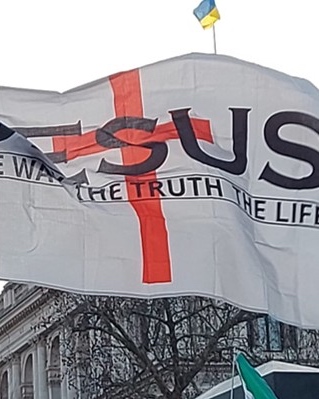 Well, Tommy Robinson said that his carol event would be only about Jesus Christ, and do you know, he pretty much achieved it.
I haven’t attended a Tommy Robinson event before. I’ve carefully watched videos of the event held in Trafalgar Square in July 2024, and of the Unite the Kingdom rally in September 2025. But this is the first time I’ve attended one in person, and I did so with some trepidation (and a hat pulled well down over my eyes—I did not want to be picked up on some BBC newsreel).
In this post I will first try to describe the event as I saw it, and then offer a few reflections.
The crowd
First, a brief word about the crowd. It wasn’t that large. Most estimates for the Unite the Kingdom event suggested around 150,000 people attended. This time there were nothing like that many. No doubt we’ll see some formal estimates over the next few days—my rather amateur guess would be a couple of thousand [The Times says around 1000].
There were three different types of attendee, by my observation. Some were there out of a sense of concern about what might be going on. These included observers (myself included), and others who were there to conduct their own evangelism by handing out literature or preaching from within the crowd.
There were also a good number of people who seemed to have been there out of Christian devotion, enthusiastically joining in with the prayers and the carols and perhaps wearing or carrying symbols that pointed to their faith. (Incidentally, I only saw one clerical collar apart from people on the platform.)
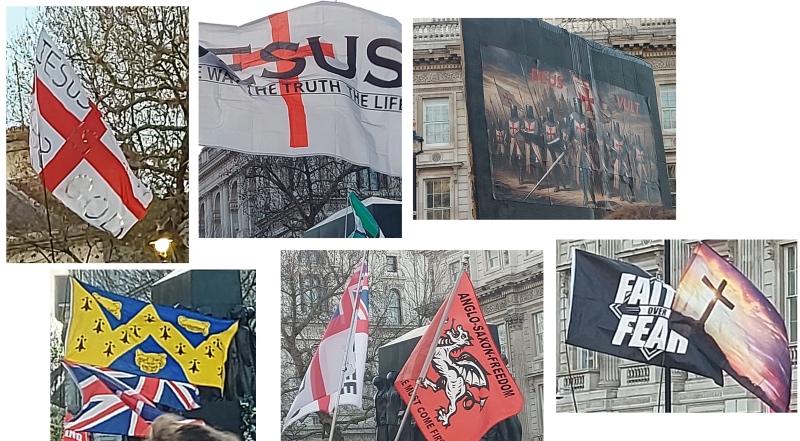
And there were quite a few people who were obviously attending on the ‘patriotism’ ticket, as their flags, tattoos, or slogans indicated.
In demographic terms, the crowd was largely buy by no means completely White. There were quite a few children and families, and quite a large number of people who would probably self-describe as working class.
I saw no scuffles or drunkenness. In fact, I’m told that anyone showing any signs of intoxication was shown off the premises by the security staff.
The heterogeneous nature of the crowd was reflected in the array of flags on display. (Apologies for the appalling quality of my camera-phone photos.)
The speakers
When I have spoken about Robinson’s previous events, I have made a point of focussing on who was platformed, and this is what I will do again here. After all, you can’t control who turns up at an event, but you can control who you give the mic to. But this time, there was no Elon Musk claiming ‘violence is coming to you’. This time, there was no Brian Tamaki calling for the ban of the public expression of all faiths but Christianity. This time, it was simply a line-up of Christian leaders[1] sounding for all the world as if they were in church.
The event was hosted, and the music led, by Rikki Doolan, the pastor who has previously sported a Union Flag jacket on the stage at Robinson’s events. Today he was looking less colourful in a plain dark jacket. The programme was slickly put together, with multiple short contributions interspersed with carols—some clearly more familiar than others to the crowd.
The first spoken contribution was by the Welsh bishop Cei Dewar. His speech in Trafalgar Square last year was notorious for its rhetoric of being ‘at war with… the Muslim’. Not here. Listening to him praying up a storm, I could have been standing in a Welsh non-conformist chapel during the Great Revival. No politics, just passionate prayer that the name of the Lord be glorified. Amen to that.
And this set the tone for every speaker after him, as priests and ministers stood up to read Scripture (a lot of Scripture, which delighted me) and to preach—there’s no other word for it.
Jesus Christ was born in Bethlehem, a small insignificant town… the Son of God in a body just like ours… God so loved the world… What difference will all this make when Monday morning comes?… You are not an accident. Your heart will be restless until it finds its rest in Him… The day of wrath is coming… Jesus lived with us sinners, but believe in him and you will be saved… This is the only God who will meet you down at your level.
And much more in the same vein.
There was plenty of testimony, too. Speaker after speaker spoke of how God had met them in the darkest moment of their lives. There were stories of miraculous interventions, and suicidal ideation turned around. Christ caught me when I fell.
There were multiple explicit calls for conversion—what I might almost have termed an altar call, in a different setting. There were challenges to find a church. ‘If you can attend a demonstration on a Saturday, please attend church on a Sunday’. There was even an invitation to repeat, line by line, a ‘prayer of commitment’ led from the front, after which we were encouraged to turn to a neighbour and tell them ‘you are saved’.
By this point we were almost an hour and three quarters into the event, and there had been no sign of Tommy Robinson himself. (Except that I saw him behind the stage when I went for a little explore before it started.) We had even had the final blessing, and I and others were starting to wonder if he would make an appearance at all.
Finally, to much applause, he came on stage. And he, too, stuck to the promise that he wouldn’t talk politics, choosing to speak, instead, about his own faith journey. He said that in 15 years of activism, this was the most beautiful moment he had seen.
In words that sounded quite emotional, he said that the church had stood against him when he began his activism in 2009, and that this had driven him away from the church. He described how he had found faith in prison, when he was involved in a weekly Bible study, and that he discovered a Jesus who stood with the sinners. ‘I’ve lived a life of sin.’
Some comments on the tone
And no politics? Well, genuinely very little, throughout the whole event. I was particularly on the look-out for comments about immigration, Islam, or cultural invasion. Nothing. Not even—as far as I could detect—any dog-whistling along those lines. The message of ‘putting Christ back into Christmas’ was certainly present, but it was framed in terms of commercialism and secularism, the hollowing out of the soul of the nation, and the need to restore the flame of our forefathers.
I won’t pretend I liked it all. Several speakers addressed the crowd as ‘patriots’, which is language that troubles me in what was essentially a worship event. There were frequent chants of ‘Christ is king’, which I find conflicting.
For sure, I believe Christ is king, but the use of this phrase as a slogan seems to be signifying something rather more belligerent than suits the Servant King whose kingdom grows like yeast. I was troubled by the very male-dominant speaker line-up, especially in the context of a rhetoric that became gradually more muscular as the event went on. The ‘prayer of commitment’ contained no reference to repentance. There were several swipes at the Church of England. And some of the preaching rhetoric was not what I would choose to employ.
But a worship event without politics? Yes, it pretty much was, at least from the stage. Whether everyone in the crowd was satisfied with that is another matter.
‘Church-washing’?
In a statement I made to the Press Agency[2] on the eve of the event, I expressed wariness about Robinson’s intentions.
We distrust Yaxley-Lennon’s [Tommy Robinson’s] motives, believing that it’s disingenuous of him to suggest that this is an apolitical event. The message of rescuing Christmas that he is putting out is entirely consistent with his previous messaging that we need to recover our Judeo-Christian heritage (which he uses as code for a range of impulses against Muslims).
In the previous events Yaxley-Lennon has organised in London, he has platformed a bishop who said ‘We are not at war with just the Muslim’ (Cei Dewar, Tommy Robinson rally July 2024), and another church leader who explicitly called for the forcible ban of all religions other than Christianity, claiming that there is a ‘religious war’ of ‘Christianity versus the rest’ and that we need to ‘clean our countries up’ by ‘getting everything out that does not receive Jesus Christ’ (Brian Tamaki, Unite the Kingdom Rally Sept 2025). These are dangerous words.
Further, Yaxley-Lennon is a man with multiple convictions for fraud and violence. I and many others who have been watching the unfolding situation over the last few years have good reason to distrust the intentions which lie behind this carol event, whatever plausible gloss is put upon it.
So should I eat my words? An honest assessment of today’s service must admit that – on the basis of what was said from the platform – Robinson’s promise to be apolitical was, at least today, on this occasion, kept in good faith.
Many of us who are parents will be familiar with the advice that, rather than telling a child ‘you’re unkind’, we should comment instead on the behaviour: ‘that was an unkind thing to do’. Today’s event challenged me to think similarly about Tommy Robinson and those who stand with him. Rather than blanket-condemning them for the things they have said and done, perhaps we should comment on particular moments, particular actions. Tommy Robinson may have said some racist things in the past. He didn’t today. We can say the one thing without unsaying the other. None of us is entirely monochrome, and growth (and repentance) is possible.
However, as Jon Kuhrt has shown, the public messaging around the event was much more sanitised than the emails Robinson sent out to his supporters. In public, the message was ‘this event is all about Christ’. The emails were more sinister. For example:
Sadiq Khan doesn’t own London, he is a coloniser and unwelcome guest, yet he thinks he can dictate when we hold patriotic events! He will hate the fact that real Christians are celebrating Christmas on his patch.
This must temper any naïve optimism, as it lends credibility to the theory of those who will say that the carol event was ‘church-washing[3]’—a public relations stunt to bring his agenda more into the mainstream.
A new disciple?
So is it possible that Tommy Robinson has truly converted to become a follower of Jesus Christ, and that this event marks a turning point (no pun intended) in his campaign?
From what I observed, I find it plausible that he did indeed make some sort of Christian commitment while in prison. But, as I have said before of other highly-publicised conversions, we will need to await the evidence of fruit, in accordance with Jesus’ instructions (Matt 7:20). Entering the kingdom of God changes all our allegiances and challenges all our ideological commitments. We cannot simply carry on as before but under a new badge. The confession that Jesus is Lord calls us all to submit to the upending of our entire value-system; the reshaping of our entire worldview. This is what repentance entails. We simply may not continue in exactly the same deeply-grooved pathway that we have been travelling.
However, we do—or we should—believe that God can turn around the lives of violent men. We think of the apostle Paul, literally stopped in his tracks as he was heading to Damascus to persecute the Christians there (Acts 9:1-22). His encounter with Jesus Christ turned that ‘worst of sinners’ (1 Tim 1:15) into an ardent disciple.
So I wonder if this story might offer a challenge to the contemporary situation. For the believers in Jerusalem, the idea that their persecutor might have converted was implausible, and not something they were willing to entertain—they took a good deal of convincing (Acts 9:26-27). This was understandable, in view of the danger Paul (as Saul) had presented, but it’s a sobering thought that the church might have shut down the ministry of the greatest apostle before it even began, if it weren’t for Barnabas.
But Paul’s conduct after his conversion is instructive, too. After his initial flurry of (perhaps over-)enthusiastic preaching in Damascus, he retreated to Arabia. This was time for him to study, to learn, to allow his mind to be transformed and to get onto the right page. It was only after three years that he returned to the church, prayerfully trained-up and ready to be of service. Tommy Robinson might take a leaf out of this playbook.
So, how might we respond to the Tommy Robinson carol service of 2025, and to his claim to have been converted to faith in Jesus Christ? I suggest: with the wisdom of serpents but with the inncocence (optimism?) of doves. This might mean: with tentative generosity of spirit; with (a sliver of) hope but (gracious) caution; with faith in the God who can change the hardest of hearts, and with prayer that we might have the wisdom to discern whether this just possibly might be happening.
I am a great sinner, but Christ is a great Saviour.
John Newton.
Helen Paynter, PhD, is the Founding Director of the Centre for the Study of Bible and Violence, where this reflection originally appeared. It is republished with permission.
Helen has been leading a project on the use of Scripture and Christian imagery by far-right groups since 2022. This has resulted in the publication of one edited book (co-edited with Maria Power) The Church, the Far Right, and the Claim to Christianity. A second edited book, Faithful Presence in a Fractured World: A church toolkit for far-right resistance will be published by Canterbury Press in 2026.
-
[1] I don’t have the names of all the participants. I’ve named the ones I could identify, and will add in other names if they are named in other reports.
-
[2] I think this was picked up by the Daily Mail.
-
[3] A term adapted from the term ‘green-washing’ used by climate activists.
Do you have a view? Share your thoughts via our contact form
Baptist Times, 16/12/2025