The stained glass ceiling is shattered...
Readable fictional account of the first female Archbishop and the consequences
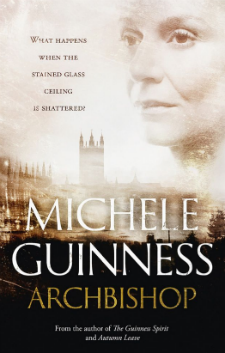 Archbishop
By Michele Guinness
Hodder & Stoughton
ISBN: 9781444753370
Reviewed by: Andrew Kleissner
The Church of England has, as we all know, undergone many upheavals and divisive debates in recent years. One of the longest running has been over the ordination of women to the Priesthood and then to Episcopal office.
In some quarters the decisions to do so have been greeted with great joy as the breaking of a “glass ceiling” and the righting of an institutional wrong. For others they have been a source of deep anguish and despair.
But one question still remains unresolved: what would happen if a woman were to be appointed to the “top job” of Archbishop of Canterbury? What would be the consequences, not just on the English Church but on the nation as a whole and the worldwide Anglican Communion? And would the pressures of the role prove too great for one person to bear?
These, and more, are the questions which Michele Guinness seeks to answer in this novel.
Victoria Burnham-Woods – “Vicky” for short – is a determined high-flyer. A graduate of Harrogate Ladies’ College and Durham University, she knows she wants to be a priest long before women were ordained. In her younger years she experiences the pressures of ministry in an inner-city parish.
Her rise through the ranks of the Anglican hierarchy provokes both prejudice and encouragement, sometimes from surprising quarters. Along the way she encounters love, marriage, motherhood and the need to reconcile two peoples’ pressured careers. Ultimately, after a chain of events following the bizarre death of its former occupant, she arrives at Lambeth.
But is her appointment a mere “token”? Has Vicky been chosen as a “fall guy” for the Anglican Church to work out its many differences? Will she manage to reconcile her liberal views on some issues with her more conservative ones on sexuality? And will she be able to redefine the relationship between Church and State in a secular society which increasingly regards religion as an unwelcome intrusion? Clearly her task will not be an easy one.
It would be easy to dismiss this book as a racy Joanna Trollope-style saga. But Guinness uses it to touch on many – possibly too many – serious matters: the place of the church in society, the scope of its social outreach, and the fear of restricting free speech in the name of secularism and security.
It also deals with issues that, while centred in the Church of England, have wider ramifications: gender and marriage, Establishment and the role of the monarch, and the varied views within the Anglican Communion.
There is much in this tale which will be familiar to Baptists: the endless treadmill of meetings, the vindictive pettiness of church politics, the constant shortage of money, the tension between “maintenance” and mission. But other aspects of Anglican life are markedly different: its complex bureaucracy and hierarchy, the place of privilege, and above all the complex relation with the State.
There are some niggles, it is true. Guinness’s constant use of flashbacks, often used to introduce new characters, eventually irritates. So does her constant quotation of the eminent theologian Jurgen Moltmann. Vicky’s father confessor and spiritual director is just a little bit wise and gracious to be true; while her lifelong Jewish friend teeters on the edges of stereotype.
But there are some sly pokes of humour, as well, such as references to starchy church catering (even worse when provided by the Methodists) and to the graduation ceremony of “Holy Trinity Brompton Christian University”.
Clearly real-life events have overtaken this story. For the first female appointment of a Diocesan Bishop has already been made. It was the Conservatives who came to power in 2015, not Labour. And Justin Welby (happily) bears little resemblance to the current Archbishop portrayed here.
But none of this matters. For this lengthy book which, at times, reads rather like the screenplay for a Sunday night television series, is both readable and enjoyable.
Andrew Kleissner is the Minister of Christ Church (URC/Baptist), Ipswich.
Baptist Times, 23/07/2015