Freedom with Foundation: The George Beasley-Murray Memorial Lecture
The interplay between theological faithfulness and theological freedom formed the basis of the last ever George Beasley-Murray Memorial lecture
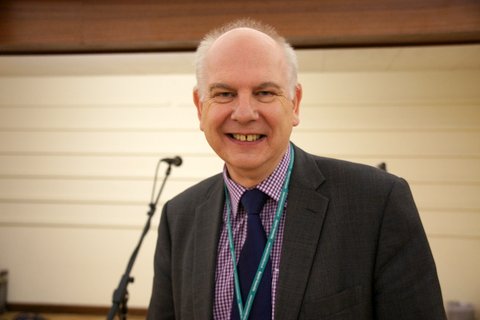
Particular attention was paid to the Michael Taylor Christological controversy of 1971 in the address given by the Revd Dr Nigel Wright (pictured), principal of Spurgeon's College, on Friday afternoon as the Baptist Assembly opened at Westminster Central Hall in London.
The George Beasley-Murray Memorial lecture was established for a 10-year period in 2002 with the intention of extending the legacy of the leading Baptist New Testament scholar of the 20th century.
Dr Wright delved into Baptist history as he spoke on the title 'Sustaining Evangelical Identity: Faithfulness and Freedom in Denominational life'.
He referred to the 19th century Downgrade controversy, in which Charles Haddon Spurgeon played a major role, stating that somehow the 'spectre of theological downgrade had lingered within the denomination throughout the 20th century'.
This threatened to come to a head following the 1971 Assembly address by Professor Michael Taylor on the person of Christ. Taylor imagined himself being asked to draft a modern replacement for the article on Christ in the Nicene creed, and emphasised the humanity of Christ.
However his suggestion 'threatened to break the Union asunder', with some seeing it as a denial of the divinity of Christ; others defending the freedom to explore the content of Christian belief and to advance new constructs.
Though some churches left the Union, a more radical schism was averted 'by means of a strong and unequivocal reaffirmation of orthodox and evangelical doctrine,' cemented by an overwhelmingly passed resolution at the following year's Assembly.
This, Dr Wright explained, was a positive step in the life of the Union: strengthening it as 'a Union of firm theological and Christological conviction', which in turn enabled it to withstand 'somewhat better than some other historic denominations the corrosive acids of the second half of the 20th century'.
Yet the Union's reaction didn't open the door to intolerance - an indication that 'it is possible to maintain faithfulness to the doctrinal tradition whilst not stifling the proper freedom that belongs to theological enquiry'.
Crucially that 1972 Assembly resolution was accompanied by the rejection of an amendment calling for the discipline of those who denied or contradicted the Union's Declaration of Principle. A core issue in the controversy alongside its Christological aspects was to do with tolerance, Dr Wright added. Significant voices in the Union argued not in favour of Taylor's views but of his right to explore them.
Baptists prize freedom, he continued, but the freedom they prize in the wider society differs from the freedom they celebrate in their own churches and communion. Within the church they are free to believe but within the bounds of a confessional community.
So in its 400th year of existence the essence of Baptist identity might include such aspects as freedom from state control, freedom from ecclesiastical domination, and freedom of religious expression, Dr Wright said.
But prior to this 'our evangelical identity is rooted in confession of a creative God who is revealed in his Son Jesus Christ, who has purposed the redemption of human beings through the incarnation of Christ and his atoning death on a cross, who has raised Christ to life so that he may be the means of our present and eternal salvation and who is about the work through the Holy Spirit of electing a people for himself and for his purpose.'
And it is this foundation which will determine the future health of the denomination, Dr Wright contended.
'These are the convictions and doctrines that will sustain us and which we simply assume or neglect at our peril. We have freedom to elaborate and interpret these teachings in many and various ways, but the future of this denomination requires us to be faithful to them with all our hearts.'