Jazz Spiritualities: The Natural Noise of Good
Regent's Park College, Oxford is hosting a series of lectures and one concert performance seeking to explore the inextricable links between religion (Christianity above all) and jazz. Andrew Taylor explains more
 A lesser-known poem of Philip Larkin’s is his homage to the great early 20th century American saxophonist, Sidney Bechet. Never until later in his lifetime given the recognition that was his due (he was, for example, recording some time ahead of Louis Armstrong’s own famous Hot Five and Hot Seven outings), he provided for Larkin an exemplar of what the best in jazz could be.
Larkin had no time for any development in the music from BeBop (the 1940s onwards), but his poem in Bechet’s memory is full of his love for this musician especially. On me your voice falls as they say love should, Like an enormous yes, is just one memorable phrase.
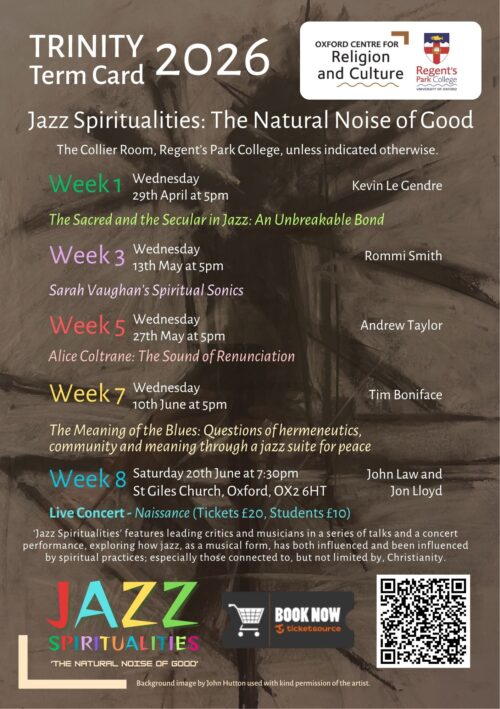
Another is that which supplies part of the title to this series on Jazz Spiritualities at Regent’s Park College Oxford this coming Trinity Term. The Natural Noise of Good is a series of four lectures and one concert performance seeking to explore the inextricable links between religion (Christianity above all) and this most sacred and profane of musical forms.
Many American jazz musicians were brought up in the church, even if they left it behind in later life. As a teenager John Coltrane was allowed to practise in the sanctuary of his local Baptist church out of hours; the only place where he could experiment with the notes and ways of playing that came to characterise his later, unique, sounds on the saxophone. The British instrumentalist John Surman once reflected, after hearing in later life old recordings of his singing voice as a church chorister, how much the sound he made then was reflected in his voice on the soprano saxophone.
We are very fortunate in our line-up of speakers.
Kevin le Gendre begins the series on Wednesday, 29 April on The Sacred and Secular in Jazz: An Unbreakable Bond. Kevin is one of the UK’s leading jazz critics, writers and broadcasters. and writes for a wide range of publications, including Jazzwise, MusicWeek, Vibrations, The Independent on Sunday and The Guardian. He has also done significant work on radio, including being a presenter on Radio 3’s J to Z and a contributor to Radio 4’s Front Row, as well as being awarded Jazz Journalist of the Year at the 2009 Parliamentary Jazz Awards.
On Wednesday 13 May we welcome Rommi Smith on Sarah Vaughan’s Spiritual Sonics. Rommi is also a freelance writer, academic and broadcaster. Winner of the Northern Writers Prize for Poetry, she has been awarded prestigious fellowships, residencies and commissions, from organisations and institutions ranging from the BBC to The British Council.
In 2025, she was appointed a judge for the Forward Prize for Poetry. Her academic scholarship centres jazz and blues women and civil rights. This academic research has led indirectly to two series for BBC Radio series Full Moon on Progress St. Both series are still available on BBC Sounds.
We move away from Christianity to Hinduism with the third lecture on Wednesday 27 May in the series on Alice Coltrane and the Sound of Renunciation. Alice, the second wife of John Coltrane and the pianist in his later bands, lived very much in his shadow until his death in 1967. After which, leaving her Christian upbringing behind and privileging her second instrument the harp, she wrote and performed music influenced by Hindu spirituality, even creating an ashram in California in the 1970s and taking the name “Turiyasangitananda” (which translates as the Transcendental Lord’s highest song of bliss). I am the third speaker in the series.
Which then concludes on Wednesday 10 June with Tim Boniface, the Anglican chaplain of Girton College in Cambridge, speaking to “The Meaning of the Blues: Questions of hermeneutics, community and meaning through a jazz suite for peace”.
Tim, an accomplished jazz musician in his own right, has recently released his latest quartet album Psalter: Themes for Peace, a series of three jazz suites that explores scriptures on peace through instrumental composition and improvisation. He will use this composition as a starting point to discuss questions around the ways sacred text is read and experienced in communities of faith, and questions around the relationship between music and meaning.
To accompany the lecture series, we have a final concert performance, to be held at St Giles Church in Oxford on Saturday 20 June. Enormously grateful to the parish church and its own organisation Jazz at St Giles, we shall welcome John Law and Jon Lloyd’s Naissance project. Both are internationally renowned musicians, and both used to performing their music in sacred spaces of various kinds. Reviewing the duo in the Guardian in 2024, its resident jazz critic John Fordham wrote of the performance that it was “A subtly intimate collection of gentle, ambient ballads and glittering, distantly Chick Corea reminiscent dances, with Law’s coaxing harmonies sensitively framing Lloyd’s warm tones.”
Andrew Taylor is an Anglican priest and a former research associate in The Oxford Centre for Religion and Culture. He presently serves in a local parish in Cheltenham, where he lives.
His academic interests lie with the rich and varied interdisciplinary conversations between theology and literature, but also with jazz music to which he has been listening since his mid-teens. It is in that capacity that he is the curator for this particular project in Jazz Spiritualities.
Baptist Times, 24/04/2026